
By Nefise Kahraman
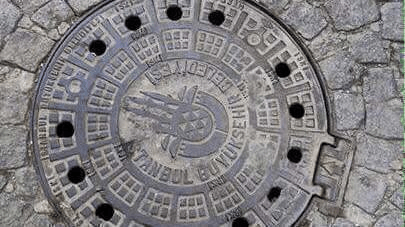
“The Cover” is a story from Turkish author Neslihan Önderoğlu’s 2012 short story collection titled İçeri Girmez Miydiniz? (Won’t You Come in?). As translators, we are delighted to bring a story by Neslihan Önderoğlu into English for the first time. You can read our translation of the story in the newest edition of Y’alla, the University of Texas’ Center for Middle Eastern Studies’ journal of Middle Eastern literature in translation.
The story revolves around two municipal workers as they attend the overflowing sewage system. An ordinary workday is soon tainted by one character’s indiscretion when he, Rıdvan, mentions his wife’s pregnancy and dispenses unsolicited advice to his co-worker Ahmet, who could not have a child with his wife. Ahmet’s long-brewing frustration with his circle of relatives and friends who like to meddle in his private matters culminates in the final act of the story.
A poignant story that slowly builds up to an unexpected ending, “The Cover” is also noteworthy in its representation of a job that remains on the fringes in a highly mechanized and corporate modern world. The disdainful treatment that the workers endure from the coffeehouse owner is an indication of how jobs like this tend to be perceived: something to be handled swiftly and out of sight. Despite being essential for the social good – somebody must go down into the sewage system to fix it – the job itself and the people who perform it are seen as inferior. This is just one example of how the author conveys the deeply hierarchical nature of Turkish society.
The group of translators working on the story was mostly concerned with certain cultural specificities that readers who are unfamiliar with the source culture could have difficulty following. One such instance is when Rıdvan brings up the Jacket Hodja (Caketçi Hoca in Turkish) in the hopes of helping his friend have a child.
A hodja is by definition a religious teacher (and could be an imam), but the word is also commonly used in Turkey as an honorific meant to show respect – for example, students often call their teachers/professors “hocam,” meaning “my hodja.” In this story, however, the hodja figure is a self-proclaimed saint who claims to heal people and relieve them of their problems. This “saint” often attracts gullible people through word-of-mouth. Thriving on people’s credulity, hodjas like this practice their “magic” across Turkey for a fee, even though it is a minor crime under Turkish law. The translators discussed whether the word hodja and the incident recounted in the story about the Jacket Hodja conveys the quackery hidden behind it. While going over our translation choices during editing, we decided that replacing “hodja” with “religious quack” would be taking too much liberty and intervening in the telling of the story, so we kept it as it is.
 translation attached