
by Nefise Kahraman
Translating a story can take us to regions and historical periods where everyday household items, decorative pieces, or the interior design of houses can differ greatly from what we are accustomed to seeing in our everyday lives. The story collection we collectively translated and published this past October, Stories of Exile by Refik Halid Karay, is replete with such examples. See, for example, the story “The Water Jug,” which takes place in Lebanon in the early 20th century. The story centers around a young man who is stung by a wasp in a remote village and is being rushed to the city hospital in the same car as the narrator. It includes a passage describing a peculiar vessel used for drinking water in this far-off Lebanese village:
“In Lebanese villages, they don’t drink water the way we do. When you go somewhere for the first time, such as a rural coffeehouse or a village house, and ask for water, they’ll bring you a tiny clay jug with a minuscule, short spout on the side – a test of skill in the form of an uneven bottle. Don’t you wait for a glass, because you won’t be using one. But it’s also rude and forbidden to touch your lips to the jug. So what then? Well, instead, you raise this jug well above your head with your right hand, open your mouth to the skies, and carefully pour the water down your throat from above!”
In another story from the same collection, the words ewer, pitcher and jug are used in the same paragraph, which compelled us to do some quick research to ensure our word choices were as accurate as possible:
“After saying this, the antique-dealing sheikh gestured towards the rooms as if to say, “Walk around, take your pick!” and went back to reading the book in front of him. I did not move an inch, for I knew nothing about ewers; all I knew were the yellow basin pitchers used in my childhood, as well as basic copper ewers. All of their spouts, for whatever reason, started at the base of their round bodies; that was how they differed from jugs.” “The Antique Dealer”
While translating the story “The Water Jug,” we recalled our previous translation of the word testi (jug) from “The Antique Dealer,” and revisited the image we had found online that corresponded to the item depicted in the passage. Google Images has proven to be a great resource for our translation work, delivering visual representations of the items detailed or mentioned in the stories, and we often rely on this tool in our workshops. My recent visit to the Metropolitan Museum of Art (the Met) in New York City added a new dimension to the act of visualizing everyday objects, such as glass or earthenware household goods, dating back to earlier times in human history. The fact that we’d taken care to research and translate the names of such objects gave me a sense of fascination once I encountered them in the museum.

A gigantic building overflowing with a breathtaking collection of art and artifacts, the Met urges its visitors to pick a handful of collections to see per visit, and leave the rest for a future trip. Submitting to this suggestion, I roamed the African and Egyptian art collections, and wrapped up my visit with yet another stroll through the Islamic art collection. Although it was not my first foray into this particular section, this time I was exploring it as one of the translators and editors of literature taking place in the early 20th century Middle East. The stories were still fresh in my mind. The objects on display that stood out to me the most were the ones described in the stories and that we had reflected on how to translate. They were also ones that I had apparently walked past during my previous visits without noticing them. (Granted, there is so much to look at that after a while, you feel dizzy and stop truly seeing the pieces, only glimpsing them in passing.) It seems as if trying to find out what those objects were called in English inscribed them firmly in my mind. Noticing all those pieces I had previously overlooked got me thinking about the intensity of the engagement that the practice of translation demands. My experience as a translator had granted me a pair of discerning eyes sharpened by the tapestry of images the original author had woven into the text. Those were no longer random objects that evaded my attention, but familiar enough to make me have an “Aha!” moment and stop to take a closer look.


Of the many objects on display, I found one to be especially interesting. It is not, in fact, a single object, but rather a room of a house: the qa’a, or sitting/reception room. One of the centerpieces of the Islamic art collection, the qa’a attracted my attention because it appears in another story we translated, “An Interim Marriage.”
“I was in a qa’a adorned by arabesque furniture inlaid with mother-of-pearl. Water flowed endlessly in the middle of the room, pouring from a marble fountain and passing through troughs large and small.” “An Interim Marriage”
The word we needed to translate – written as kâa in the original Turkish text – required some research on our part, including some consultation with someone who knows Arabic and could help us find what we were looking for. Mehmet Hakkı Suçin, a professor of Arabic literature and literary translator based in Turkey, kindly explained what a qa’a is to us, evoking the image of the sıra gecesi, with which we were familiar. (A sıra gecesi is a gathering, usually but not always exclusively attended by men, that features live music and food, and is most commonly associated with the province of Urfa.) Seeing the qa’a staged in the museum transported me back to the story; I replayed the scene in my mind where the narrator anxiously waits in the qa’a of a stranger’s house for what is to come.
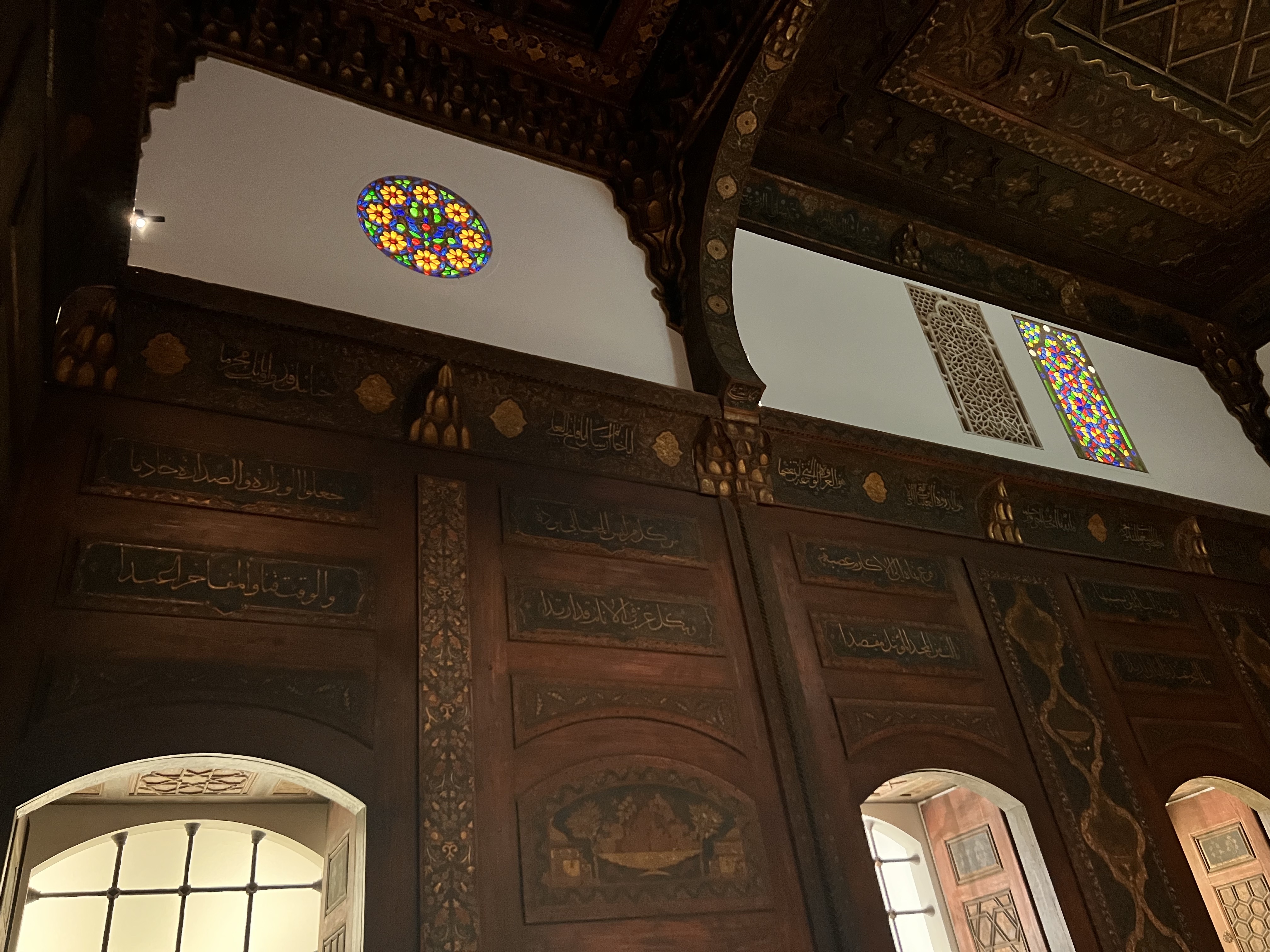


The act of translation sometimes entails becoming bogged down with minor details within the text, particularly when we are trying to faithfully recreate the imagery detailed in the original text. We spend lots of time researching and going back to check that we made sure to translate the jugs as jugs and the ewers as ewers, without accidentally confusing them. A visit to a museum that features the objects present in a text intensifies this engagement and helps us truly visualize what we had previously only seen in photographs, strengthening our ability to convey the image to our readers.
 translation attached