
By Nefise Kahraman

Do you re-read your own books after publication? Often asked in author interviews, the answers to this question vary according to the temperament and expectations of the author. Some see value in revisiting their work because it allows them to examine the writing style and to compare their older works with the newer ones, as the author Hannah Fielding believes.1 Others, such as John Cheever, have a different perspective on the matter. As we learn from his interview with the Paris Review, “he does not pay attention to reviews, never rereads his books or stories once published, and is often vague about their details. He dislikes talking about his work (especially into “one of those machines”) because he prefers not to look where he has been, but where he’s going.”2 Actors and actresses are also often asked this question. Do they watch their own films once they’ve hit the screens? This question can be redirected toward a translator: once the book you translated is published, do you go back and reread it?
In my capacity as one of the translators and editors (not to mention, publishers!) of Refik Halid Karay’s Stories of Exile, I have yet to receive this question. But if it were posed, my response would be, “Indeed, I do read the book after its publication. As a matter of fact, I read it several times, albeit begrudgingly!” My motivation for re-reading is to look back on our translation process and reconsider the linguistic and extra-textual choices we made, such as footnotes and introductory notes. In short, I revisit the text to think retrospectively about our translation choices and publishing process. “But why begrudgingly?” you may ask. Despite my growing appreciation for the book with each subsequent reading, things that escaped my notice during prior readings begin to stand out significantly, or perhaps I simply fall into the trap of over-analyzing. I will expand on that below, but first, let me tell you about a guest lecture I was invited to, which inspired this essayistic meandering.
Back in February, I attended Professor Gözde Mercan’s Advanced Turkish class at the University of Toronto as a guest lecturer to talk about Translation Attached, the weekly workshops, Stories of Exile and the nitty-gritty of literary translation. Ironically, I was the instructor for this course in 2019/20, the second half of which was overshadowed by the pandemic and moved from a classroom to an online setting. Washed over by a wave of nostalgia, I began my talk by reminiscing about my time with students. Since most students registered for the course when I taught it had been Turkish speakers, the syllabus underwent a major revision, and the course morphed into one centred on literary translation. The class set out to work on a short story, The Shanghai Noodles, by Canadian author Ted Plantos (1943-2001). A rather amusing story with an oddball main character, The Shanghai Noodles presented ample opportunities in the vein of colloquialism, wordplay, dialogue, and so on that forced us to ponder the intricacies of literary translation and develop possible strategies. What we produced at the end of the course was published in one of Turkey’s most widely read literary journals, NOTOS – coincidentally, in the issue that covered literary translation as a focal topic. The story we translated from Turkish – Sancho’nun Sabah Yürüyüşü (Sancho’s Morning Walk) – belonged to author Haldun Taner (1915-1986), a famous playwright who was also a virtuoso of short stories. The story was full of expressions that were tricky to translate. The students found the challenge exciting and rewarding.
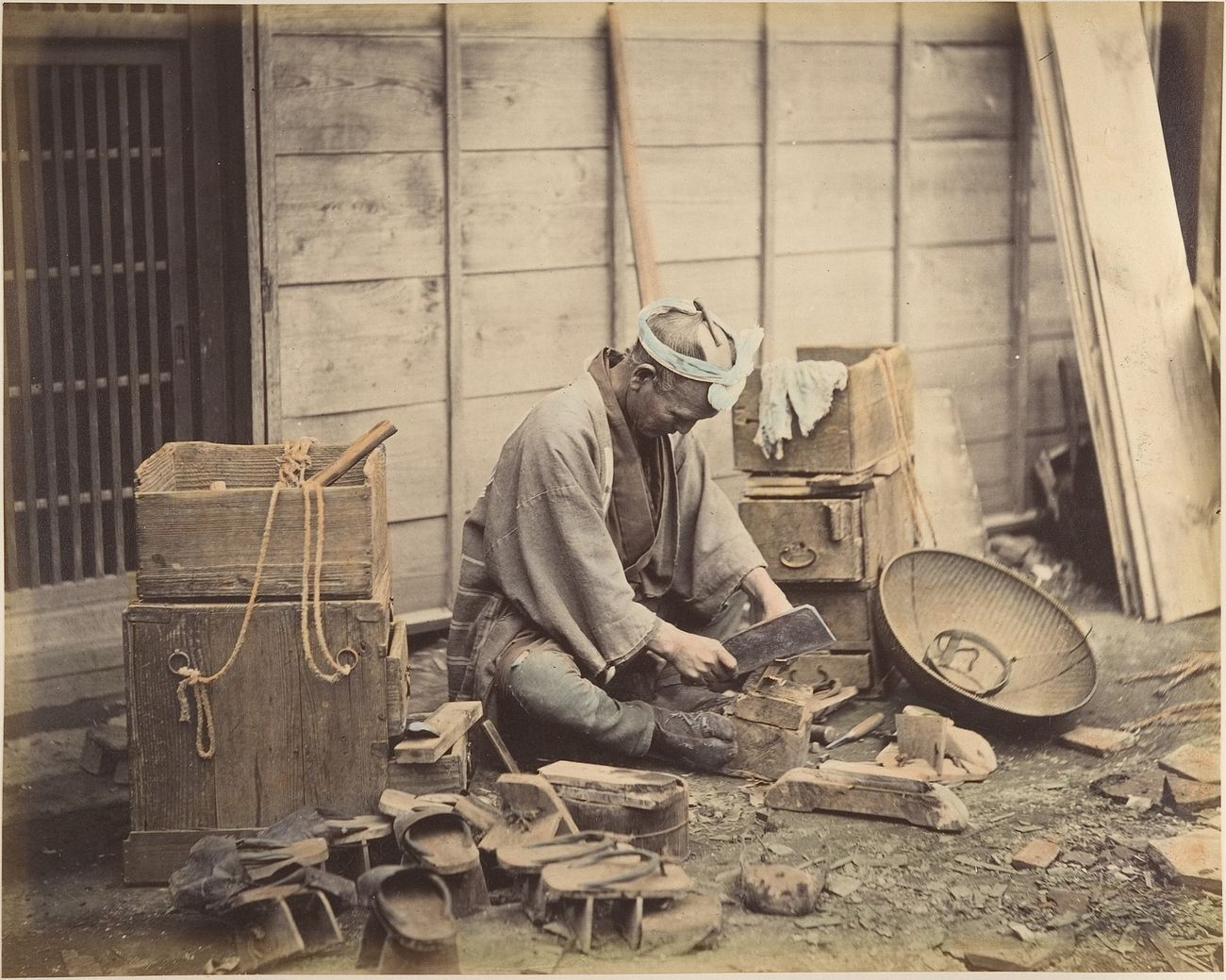
In Gözde Hoca’s class, I continued my talk with the story of Translation Attached and moved on to say a few words about the author Refik Halid Karay. Then, with the participation of the students, we looked at the story Eskici (The Cobbler) from Karay’s collection. The students were familiar with the story as they had discussed it in the previous class. The first thing I brought up was the title of the story. In Turkish, the word eskici refers to someone like a street hawker who buys and sells second-hand goods. While this is the most common usage of the word, a secondary meaning is a person who mends shoes. Although the title seems to point at a street hawker, which was our initial choice as well, we later changed it to cobbler as a better fit, given the title character’s primary occupation. In the story, Karay switches between eskici and satıcı when referring to his main character. In the case of satıcı, we used (street) hawker. For eskici, we stuck with cobbler throughout.
I then pulled out some sentences from our translation that I had been second-guessing the night before. Would it be better to articulate this sentiment with this word instead of that? Would omitting/adding a word bring the required subtlety to the sentence? Take, for instance,
1) “Don’t cry, little man! Don’t cry!”
The cobbler didn’t know what to say. Upon hearing this, the child began shaking and sobbing; he cried because he would never be able to find someone to speak to in Turkish again.
Ağlama be! Ağlama be!
Eskici başka söz bulamamıştır. Bunu işiten çocuk hıçkıra hıçkıra, katıla katıla ağlamaktadır; bir daha türkçe konuşacak adam bulamıyacağına ağlamaktadır.
The night before, while reading the book, I thought, “I feel like ‘else’ is missing in this sentence. The cobbler didn’t know what else to say?” (Why I felt that way is still a mystery to me!) When asked what they thought, it turned out that the students were not as worried about the “missing” else as I was. They liked the sentence as is. When I asked them how they would translate the sentence, they became animated, firing options one after another:
- Upon hearing this, the child began crying uncontrollably; he cried because he would never be able to find someone to speak to in Turkish again.
- Upon hearing this, the child broke into sobs; he cried because he would never be able to find someone to speak to in Turkish again.
- Upon hearing this, the child began crying relentlessly; he cried because he would never be able to find someone to speak to in Turkish again.
- Hearing this, the child began shaking and sobbing; he cried because he would never be able to find someone to speak to in Turkish again.
- Upon hearing this, the child began shaking and sobbing; he wept, knowing he won’t find another person to speak Turkish with.
By the end of the class, it became clear to me that translators might shy away from discussing their translation decisions, and understandably so. Since translation is an act of decision-making, every translator – or anyone taking a shot at translating, for that matter – can come up with a different way to convey the meaning of the original sentence. Those who are specialized in literary translation and have made a profession out of it often develop a personal philosophy – a blueprint of rules and convictions, so to speak – and translate adhering to those. Even then, upon revisiting their work, a translator might find themselves at odds with their own translation and could be puzzled by their own choices.
Should translators, then, follow in the footsteps of those authors who refrain from reengaging with their work post-publication, or should they dare to revisit their translations, despite the inherent “risk”? There seems to be no straightforward answer to this question. Ultimately, the decision rests with the translator. And I, for one, prefer to go back, albeit begrudgingly.
 translation attached