
by Burcu Karahan
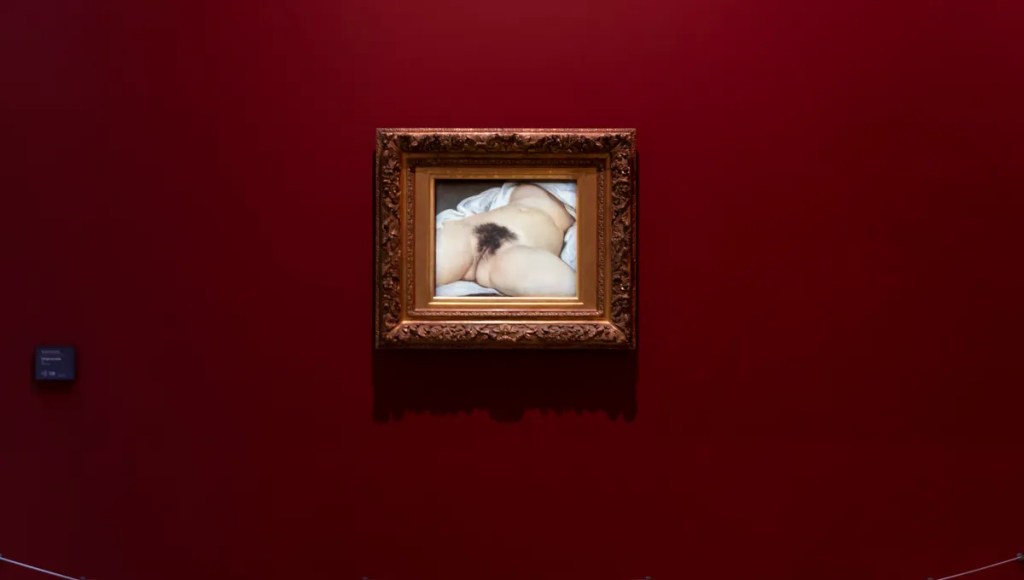
L’Origine du monde by Gustave Courbet (1866)
I’ve spent a good part of the last two years transcribing and translating One Thousand and One Kisses, a collection of sixty-five delightfully risqué short stories first published in Istanbul between 1923 and 1924, just as the Ottoman Empire was dissolving and the modern Turkish Republic was coming into being. Issued weekly by Amedi Publishing House, these anonymous tales blend humor, eroticism, and satire, which may help explain why they were so wildly popular in their time.
I had known the series for nearly two decades, having worked on it on and off. From the beginning, I was aware of the rumors that linked One Thousand and One Kisses to Mehmet Rauf, a well-known author of the period who had published what is often considered the first Ottoman pornographic novel, Bir Zambağın Hikâyesi (The Story of a Lily) (1910), and had faced legal consequences as a result. Still, no solid evidence connects him directly to this series. I was also aware, just by reading the stories in the collection, that several of them were either adapted from or inspired by European originals—French or English—though most had been Ottomanized in voice and setting. But encountering these stories as a reader or researcher is quite different from approaching them as a translator. Translation demands not just appreciation, but reanimation, and translating erotic texts, in particular, presents unique challenges, not least because the very idea of eroticism can vary widely across cultures.
As is often the case with erotica, and likely, in part, to sidestep legal trouble, One Thousand and One Kisses leans heavily on elusive, seemingly ordinary words that teeter on the edge of decorum and mischief. These terms resist direct translation: they’re provocative, playful, and deeply embedded in cultural context, making them difficult to render cleanly into English. The challenge is compounded by the presence of French vocabulary and other linguistic traces in some of the adapted stories, adding yet another layer of translingual complexity. In especially such cases, translation is never simply about finding lexical equivalents for expressions of desire or pleasure. The real task is to recreate the emotional and cultural effect those words have on the reader, an effect shaped by tone, context, and expectation.
It was precisely this uneasy negotiation embedded in the stories that made the translation journey both joyful and illuminating for me. Each slippery word or phrase felt like a small puzzle waiting to be solved, a linguistic and cultural mystery that I, as a scholar of 19th-century literature, was more than eager to unravel.
I would like to share with you two different examples of such words. Take, for example, the story “Müjgan’s Pussycat” (“Müjgan’in Kedisi” in the original Ottoman Turkish). The word kedi (cat) in Turkish is not commonly used as a euphemism for female genitalia, as it is in French (chatte) or English (pussy). Yet in this story, that euphemism was clearly intended. The deliberate choice to not replace kedi with a more culturally recognizable slang term in Ottoman Turkish suggests two things: first, that the story was either inspired by or directly adapted from a European source; and second, more intriguingly, that the erotic lexicon already included imported terms, familiar enough to contemporary readers in Istanbul that no further localization was needed. The joke, in other words, landed without explanation because these cross-cultural borrowings were already part of the shared vocabulary of the genre.
Another word that intrigued me, but also proved quite challenging in translation, was merkez, Ottoman Turkish for “center” (from the Arabic markaz). While merkez generally means the central or most important part of a place or thing, it carries a range of other meanings depending on context: it can refer to the administrative seat of a city or province, the headquarters of an institution, a center of decision-making power, or, colloquially, even a police station. But none of these conventional meanings applied when I encountered merkez in the story “Aşk Dersi” (“A Lesson of Love”), during a flirtatious exchange between Ferit and İclal, a young married woman he is trying to seduce. When Ferit begins repeating himself, İclal chides him, half-scolding, half-flirting: “You’re joking. You are an eloquent speaker, capable of explaining yourself. Or do you have no tongue?” To which Ferit replies, “My tongue? I have a tongue, hanımefendi, and it is ever ready for the merkez.”
Even if the meaning of merkez in this contextwere ambiguous, İclal’s coquettish laughter in the next line clarifies everything. “Let’s not go that far,” she says. “I just want you to explain your theory.” Clearly, Ferit’s mention of his tongue being ready for the merkez was considered not just flirtatious, it was sexually suggestive, enough so that İclal felt compelled to draw a boundary.
At first, I was puzzled. I had read my fair share of late Ottoman erotica, yet I had never encountered merkez used as a euphemism for female genitalia. How, then, had a word with no prior erotic connotation found its way into such a provocatively charged context and ended up at the center of a scene so clearly suggestive of oral sex? Was this an isolated instance—a clever, one-off coinage by the author? A playful twist on language? Or was it something subtler: a borrowed euphemism transformed through the act of translation; its erotic charge carried across languages and cultures?
“Center” in English, or centre in French, carries no such connotation either. This is to say that the case of merkez was not as linguistically transparent as, say, “pussycat.” But then I remembered something from Mehmet Rauf’s preface to The Story of a Lily, which I had translated years ago. There, Rauf describes female genitalia as the thing around which the entire world revolves. At the time, that metaphor immediately brought to mind Gustave Courbet’s famous 1866 painting L’Origine du monde, commissioned by Halil Bey, the Ottoman ambassador to St. Petersburg and a notorious art collector in Paris. The painting shows a nude woman lying on a bed, legs apart, her vagina positioned squarely at the center of the painting, visually and thematically echoing its title.
Clearly, the fame of the painting had traveled well beyond the velvet curtains of Halil Bey’s private salon in Paris where it was exhibited. Its symbolism, the female sex as the origin or center of the world, had made its way to Istanbul. What intrigued me even more was how the French origine may have subtly transformed into merkez in Ottoman Turkish, not through direct translation (since centre in the title of Jules Verne’s 1864 novel Voyage au centre de la Terre was translated into Ottoman Turkish as merkez “Merkez-i Arza Seyahat” in 1886), but through a conceptual shift.
In Ferit’s line, then, merkez isn’t just a cheeky euphemism. It’s an allusion to a broader, almost philosophical metaphor of womanhood as origin, as core. And yet translating it literally as “center” or “origin”—as in “my tongue is ready for the center”—would fail to carry either the flirtation or the meaning. In the end, I chose “core”: a word that keeps the innuendo, evokes centrality, and leaves a slight veil over the exact reference, just as the original does: “My tongue? I have a tongue, hanımefendi, and it is ever ready to serve the core of all things.”
In the end, tracing the layered meanings of merkez felt like my own little voyage au centre d’un mot: a journey to the slippery core of a single word. In that word’s surprising erotic charge, echoing both Courbet’s L’Origine du monde and Mehmet Rauf’s metaphors of feminine centrality, I found myself inching closer to the mysterious figure behind the series. Perhaps the old rumors weren’t entirely unfounded. Perhaps Mehmet Rauf, with his fondness for erotica, veiled metaphors, and his fondness for the origin of the world, really was the mastermind behind One Thousand and One Kisses. In that sense, translating merkez didn’t just clarify a line, it cracked open a door.
 translation attached