
by Nefise Kahraman
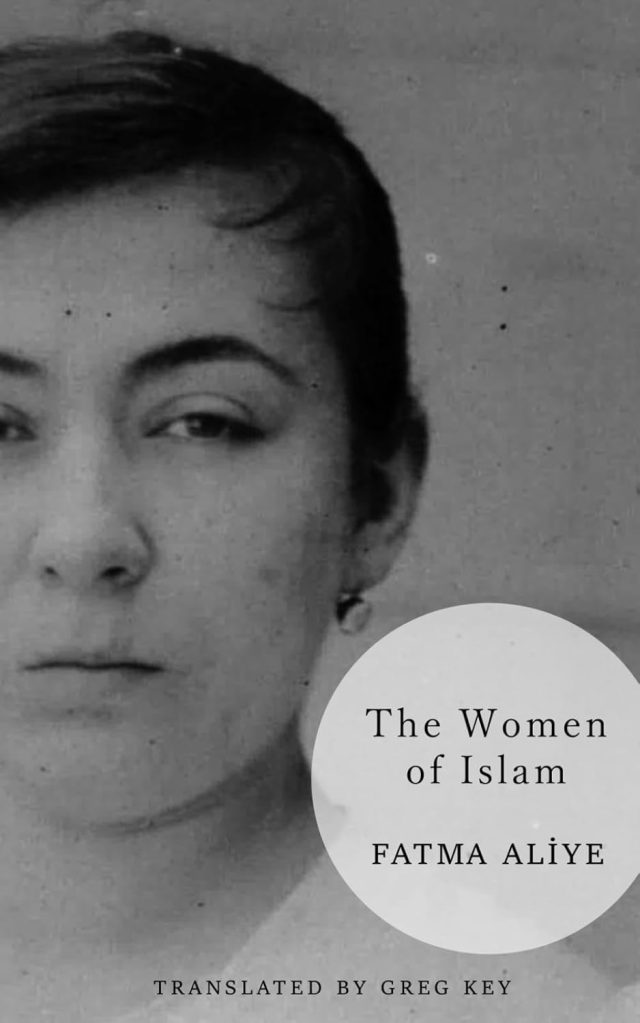
The book is available worldwide via Amazon.
“As is known to all, Europeans have nothing to say on the tenets of our religion, which are in accord with reason and wisdom, but suppose only that the women of Islam are oppressed and treated with cruelty, and this they criticize viciously. In conversations I have had with certain distinguished ladies of the traveling set, I have learned of beliefs about us held by Europeans that are so misconceived that I cannot hide my astonishment in my heart, and am compelled to write down three of these discourses, as follows.”
Fatma Aliye, The Women of Islam
Previously translated into Arabic as Nisāʼ al-Muslimīn and French as Les femmes Muselmannes,1 Fatma Aliye’s Nisvan-ı Islam (The Women of Islam) has been translated into English for the first time over a century after its publication in Ottoman Turkish in 1893.2 As part of its initial appearance in English, an excerpt from the book was published in Europe Knows Nothing about the Orient: A Critical Discourse from the East (1872-1932),3 an anthology of late Ottoman and early Turkish Republican journalism, essays, and polemics that critically engage with European Orientalist depictions of the Ottoman Empire and the “Orient.” In this volume, Fatma Aliye’s piece appears under the subtitle “‘Oriental’ Women and Life at Home,” where a host of pieces from Aliye’s contemporaries that dismantles prevailing Western stereotypes about Muslim women and their domestic spaces in the Ottoman world appear. By placing Aliye’s work within this larger conversation, the anthology underscores her importance both as a perceptive critic of Western misconceptions and as a pioneering voice in Ottoman women’s intellectual history, making her contribution especially resonant within the volume’s broader aims.
The Women of Islam draws on Aliye’s personal encounters with European travelers in late nineteenth-century Ottoman Empire. As such, the book may be classified as a long treatise grounded in the author’s memoirs. In her Bir Muharrire-i Osmaniye’nin Neşeti (The Awakening of an Ottoman Woman Writer, 1893), Fatma Aliye recounts how, during her father Ahmed Cevdet Pasha’s governorship of Syria (1878), she hosted female travelers in their home – women who wished to observe Muslim family life up close – and conversed with them in French. It is also known that the author, together with the poet Nigâr Hanım, was appointed by Sultan Abdülhamid to accompany foreigners visiting the palace – particularly their wives – and to introduce them to the Ottoman family and to Ottoman women. For this service, both women were awarded the Order of Compassion (Şefkat Nişanı).4
Written as a defense of Ottoman social customs and Islamic principles through appeals to rationality, the book challenges the misinformation and assumptions Aliye observed among Western visitors. Structured around imagined conversations with European female travelers who are invited into her home to allow them to witness the workings of a real Muslim household rather than relying on impressions formed in predominantly non-Muslim districts such as Beyoğlu, the book offers a corrective to Orientalist misrepresentations.
Aliye puts European women, who are portrayed as truly intent on understanding and as earnest pursuers of knowledge, in conversation with Ottoman women, as their questions – ranging from the lives of bondmaids to polygamy and arranged marriages – guide the discussions. Themes familiar from Aliye’s novels, including the status of women in Islam, the institution of slavery (cariyelik), and the practice of polygamy (taaddüd-i zevcat), are also discussed. Throughout, Aliye occasionally contrasts Christianity and Islam in order to dispel the stereotypes Western women bring with them when they contemplate Ottoman women’s lives.
On the question of what motivated Aliye to write this book, one may argue that she stands within a lineage of late Ottoman intellectuals who voiced strong objections to European clichés about the East – such as those popularized by Pierre Loti (the pseudonym of French naval officer Louis Marie Julien Viaud, 1850–1923). Loti’s novels Aziyadé (Aziyade, 1879) and Les Désenchantées (The Disenchanted, 1906),5 with their sensationalized portrayals of Ottoman women and harem life, became emblematic of such distortions and served as a catalyst for The Women of Islam. Famous for his Orientalist portrayals of Ottoman women as repressed, despondent, and confined to the harem, Loti helped cement many of the stereotypes circulating in Europe at the time. His novel – replete with misrepresentations, distortions, and factual inaccuracies about Muslim women and about Islam – provoked a response from Fatma Aliye, who, like several Ottoman intellectuals of her generation, was exasperated by the persistence of such misconceptions in European writing.6
In defending Islamic customs and traditions, some of Aliye’s arguments give the impression that she is describing an idealized society governed by Islamic precepts. Her portrayal of bondmaid is one instance where this idealization becomes especially visible. Though the institution was in essence a form of slavery, Fatma Aliye reframes it as a benevolent arrangement rooted in care and goodwill. This reframing can be read not only as a rhetorical strategy but also as an attempt to counter dominant Orientalist narratives that portrayed Muslim societies as uniquely oppressive. By highlighting what she saw as the moral intentions behind Islamic social structures, Aliye sought to present Ottoman domestic life as ethically coherent and spiritually grounded. At the same time, this idealization obscures the historical realities and power dynamics that shaped the lives of enslaved women in the late Ottoman world.
As a woman from an upper-class family, with an education unimaginable for many Muslim women of her time, Fatma Aliye benefited from the opportunities that accompanied her social position. Yet rather than restricting herself to the salons of elite women, she mobilized her education to advocate for women across the social spectrum. In doing so, she positioned herself not only as a voice for Ottoman Muslim women of diverse backgrounds but also as a representative for Muslim women beyond the empire’s borders – a role she made explicit in The Women of Islam. The book was exhibited at the 1893 Chicago World’s Fair alongside the author’s biography and her earlier works. Although the author did not personally attend the fair, her biography and works were included in The Woman’s Library of the World’s Fair (Catalogue of the World’s Women’s Library).
We are happy to publish the book in its complete English version for the first time, exquisitely translated by Greg Key, and believe that readers will value both its literary merit and its historical depth.
***
1 The book was translated into French by Olga de Labedeff – known as Madame Gülnar (Les Femmes Musulmanes, Paris, n.d.) – and by Nazime Roukié (Les Musulmanes Contemporaines, Paris, 1894). The Arabic iteration of the book first ran in serialized form in the Beirut-based newspaper Semeretü’l-Fünun and was subsequently issued as a book by the Press of Cemiyetü’l-Fünun. Nisvan-ı İslam is the first work by an Ottoman woman to be rendered into other languages.
2First serialized in Ahmet Mithat Efendi’s newspaper Tercüman-ı Hakikat between October and November 1891, before being published in book form in 1893.
3“The Women of Islam,” trans. Greg Key in Europe Knows Nothing about the Orient: A Critical Discourse from the East (1872–1932), ed. Zeynep Çelik (Istanbul: KUP, 2021), 167-187.
4Hülya Argunşah. “Nisvan-ı İslâm.” Türk Edebiyatı Eserler Sözlüğü. Online source. Accessed Nov 15, 2025.
5Originally written and published in French, Loti’s works were translated into Turkish only later. The first translations include: Pierre Loti, Azade, trans. Handan Lûtfi (Istanbul: Mahmud Bey Matbaası, 1342/1923); and Pierre Loti, Meyûseler, trans. Hüseyin Naci (Istanbul: Marifet Matbaası, 1338/1922).
6For further discussion of this topic, see Europe Knows Nothing about the Orient: A Critical Discourse from the East (1872–1932), ed. Zeynep Çelik (Istanbul: KUP, 2021), 13–61.
 translation attached